Sentineo successfully collaborates with KU Leuven on transforming EEG monitoring
Sentineo - KU Leuven collaboration
EEG breakthrough illustrates Sentineo's capability in turning innovative concepts into high-performance devices
The KU Leuven ESAT/STADIUS team set out to redefine EEG monitoring. They faced longstanding challenges: bulky systems, stigmatizing headgear, motion artifacts, and centralized data bottlenecks. Their response was the creation of EEG-Linx, a wireless modular EEG sensing platform, combining cutting-edge academic innovation and real-world engineering expertise. Sentineo assisted the team in optimizing the low-power hardware design, drawing on its experience in ultra-low-power IoT design. Recently, IEEE Sensors Journal reported on this unique EEG platform.
Conceptual illustration of the EEG-Linx sensor platform (front and back views) containing ultracompact sensor nodes of just 2cm × 3cm, battery-powered and wirelessly synchronized.
Ultracompact EEG sensor nodes
Together with the KU Leuven ESAT/STADIUS team, Sentineo transformed an initial concept into a tangible prototype.
According to professor Alexander Bertrand, the EEG-Linx platform results from teamwork. “Our STADIUS researchers directed the system architecture: MCU-driven wireless nodes, resistor-based biasing to eliminate DRL electrodes, and a robust firmware enabling synchronization across independent nodes, and Sentineo bridged that research with real-world industrial hardware design with minimal form factor.”
Piet Callemeyn, owner of Sentineo: “Based on our expertise in low-power hardware design, we achieved miniaturization to arrive at an ultracompact sensor node of just 2cm × 3cm, battery-powered, wirelessly synchronized, and discretely placed across the scalp.”
A new benchmark beyond wired EEG
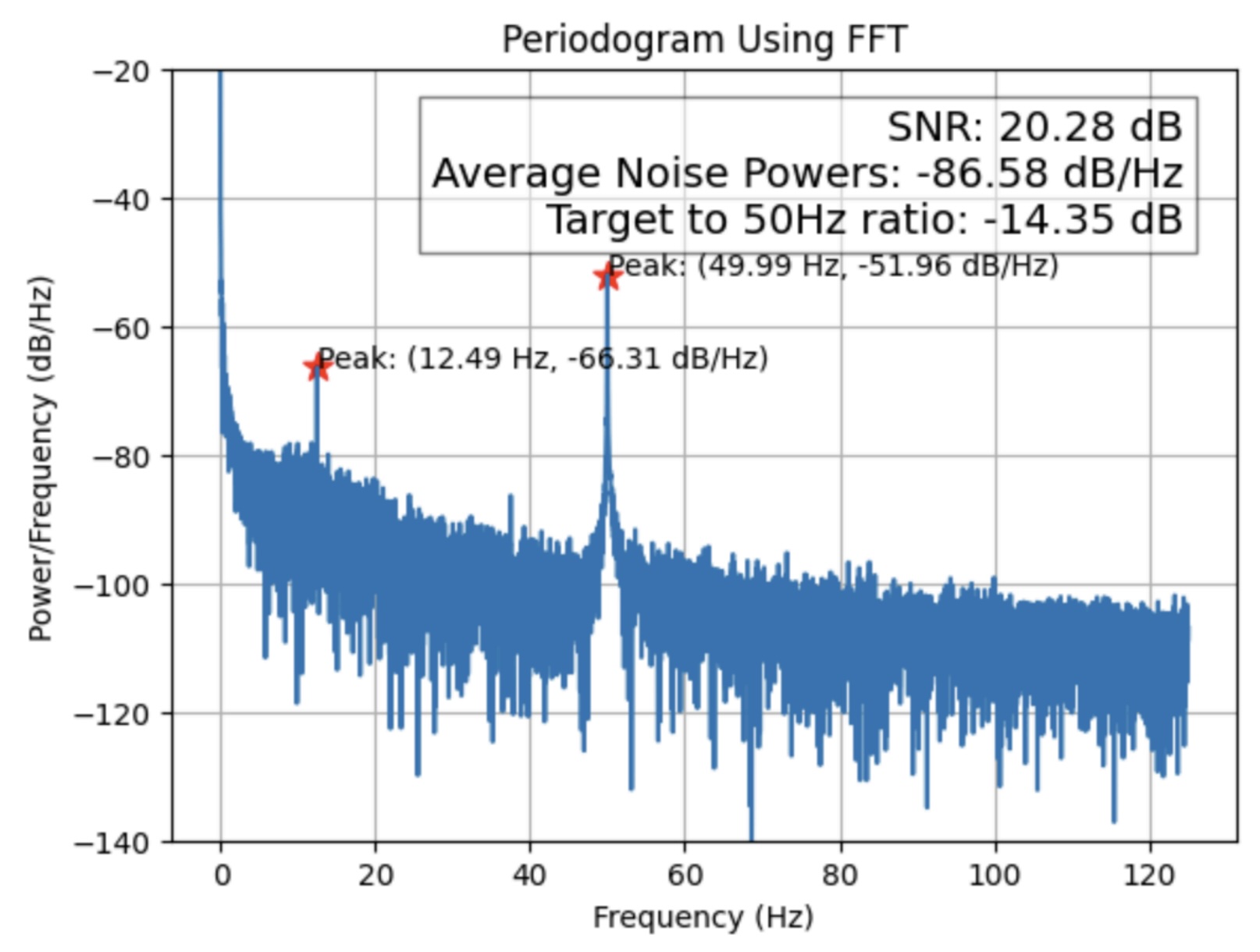
The wireless system matches and even surpasses the performance of commercial wired systems. In lab experiments, EEG-Linx demonstrated a perfect synchronization across multiple nodes, with a custom protocol that corrected oscillator drift and aligned timestamps with real-time precision. The signal-to-noise ratio of this wireless system in detecting steady-state visually evoked potentials (SSVEPs) exceeds those of established devices.
SSVEP signal quality comparison: wireless vs. wired. On the left you see a periodogram of a 12.5Hz SSVEP response during wireless transmission, on the right during wired transmission. Next to favorable signal-noise ratio, this comparison demonstrates the advantages of avoiding wired connections in reducing 50Hz interference and maintaining signal clarity.
Piet Callemeyn mentions that the EEG-Linx delivers comparable EEG quality to existing systems with significantly reduced hardware. Alexander Bertrand adds: “By stripping away a separate DRL electrode and relying on resistor-based biasing, the system maintained signal integrity while enhancing modular scalability and discreteness.”
Rigorous first-time-right approach
Piet Callemeyn: “Sentineo’s rigorous first-time-right approach led to a successful initial PCB production run, delivering fully functional hardware at the first production run. By engaging early in engineering, we maximize impact on system architecture, design choices, and product robustness. This collaboration illustrates how academia and industry can unite to accelerate innovation, here advancing a platform at the frontier of portable, discrete EEG monitoring.”
SSVEP responses captured by EEG-Linx sensor node (blue) and the commercial mBrainTrain Smarting system (green). Despite the absence of a DRL electrode, the EEG-Linx system yields a higher SNR.
In conclusion, the EEG-Linx project shows how research and industrial expertise can redefine wearable neurotechnology. The collaboration yields a breakthrough in portable wireless EEG and illustrates our capability in turning innovative concepts into high-performance devices.
Radar chart, showing EEG-Linx absolute phase differences between bilateral EEG channel pairs across six subjects, implies that the EEG signals from both ears are properly aligned in time.